Wheeler's Bridge
An early use of reinforced concrete in Victoria
PUBLIC ACCESS:
Please note that the bridge has been closed
and there is no public access
| Engineering Heritage Australia Marker No 154 |
|
|
|
Wheeler's Bridge An early use of reinforced concrete in Victoria PUBLIC ACCESS:
Please note that the bridge has been closed
|
||
|
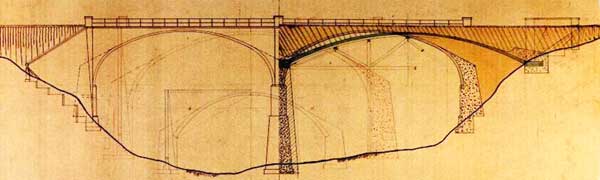
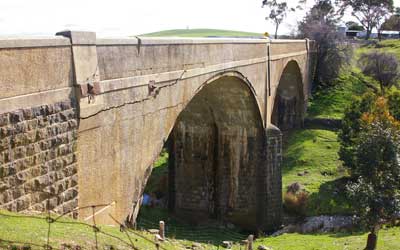
Wheelers Bridge is one of the earliest bridges built to the
Monier patent arch bridge design in Victoria. It is now the oldest of
these bridges still carrying traffic although its load limit has been
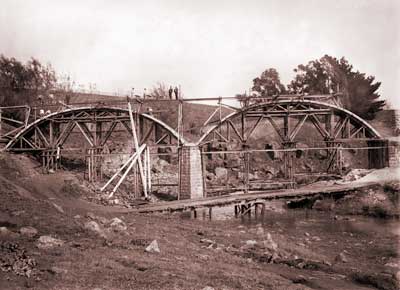
reduced to 15 tonnes. The bridge carries the Creswick-Lawrence Road across the Birch Creek. It was designed by the Melbourne consulting firm of Monash & Anderson. Jenkins Brothers of Ballarat started work on the bridge in December 1898. Monash & Anderson took over the construction in 1899 and the bridge was completed on 30 March 1900. |
 |
|
|
Monash & Anderson Why an Arch Bridge? Designing the Bridge Building the Bridge Joseph Monier James Wheeler |
||
|
General
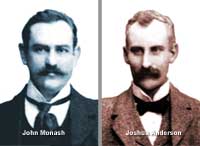
Sir John Monash (1865 - 1931) In 1905 John Monash started the Reinforced Concrete & Monier Pipe Construction Co which continued to develop the use of reinforced concrete in Victoria. Following a brilliant military career in World War I Monash became Chairman of the State Electricity Commission of Victoria and led the effort to use Latrobe Valley brown coal to generate electricity. Joshua Anderson (1865 - 1949) Joshua Anderson’s engineering career has been overshadowed by Monash's military fame. Anderson worked in various disciplines, then went to New Zealand, and later worked as a municipal and consulting engineer in Victoria. |
 |
|
|
Why an Arch
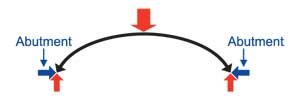
Bridge? The graceful curve of an arch bridge transfers some of the weight of the bridge and its traffic into a horizontal force resisted by the abutments. Longer bridges may have several arches. People have been building arch bridges for thousands of years. They're simple, they work, and they can be quite pleasing in appearance. |
 |
|
|
Joseph Monier --
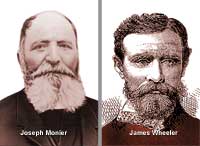
From Pots to Ponts French horticulturalist Joseph Monier devised a method of making flower pots and garden furniture by using a mesh of thin iron rods to reinforce concrete. He took out a patent in 1867 and continued to find new uses for the method which makes the best use of each material. The technique was soon applied to other structures and in 1875 Monier designed the first iron-reinforced concrete bridge (pont is the French word for bridge). James Wheeler James Wheeler was a storekeeper at Forest Creek and erected a sawmill at Wombat Forest. He served as MLA for Creswick from 1864 until 1867 and later became MLA for Daylesford. Wheeler was appointed Minister for Public Works and vice-president of the Board of Land & Works on 5 November 1890. |
 |
|
| Engineering Heritage Marker awarded 13 July 2013 | ||
| Nomination by Engineering Heritage Victoria and Hepburn Shire Council | ||
| For more information about Wheeler's Bridge,
please use the following links: WheelersBridge.Nom.pdf WheelersBridge.Panel.pdf WheelersBridge.Images.pdf For more information about the engineering works of Sir John Monash, go to: John Monash: Engineering enterprise prior to WWI |